

Can You Put a Freestanding Mini Fridge Inside Sealed Custom Cabinetry?
Deciding if you can put a freestanding mini fridge inside sealed custom cabinetry is a common dilemma for homeowners looking to streamline their home office or entertainment space. While the visual appeal of a hidden appliance is undeniable, the technical requirements for refrigeration often conflict with the desire for a completely enclosed aesthetic. Understanding the mechanics of heat dissipation is critical before you commit to a permanent joinery design.
If you ignore the need for proper airflow, you risk premature compressor failure and potential safety concerns. This article explains the technical limitations of enclosing cooling units and how to properly plan for your specific appliance footprint without compromising your home’s safety or your equipment’s longevity.
The Direct Answer: Can You Safely Enclose a Freestanding Unit?

The short answer is no; you cannot safely place a standard freestanding mini fridge inside a completely sealed custom cabinet. Freestanding refrigerators are designed to release heat through their sides, top, and rear surfaces into the surrounding room.
When you trap these units in a confined, unventilated box, the heat has nowhere to go. This creates a cycle of rising temperatures that forces the compressor to work continuously to maintain the desired internal climate.
Most manufacturers specifically state in their user manuals that their freestanding models require a minimum air gap around the unit to function correctly. By sealing a unit inside a cabinet, you are effectively creating a heat trap.
This will almost certainly lead to the unit shutting down, the contents warming up, and the compressor burning out far sooner than its projected lifespan. If you are determined to have a hidden fridge, you must either modify the cabinetry to allow for significant airflow or purchase a unit specifically engineered for built-in installation.
Understanding the Refrigeration Cycle and Heat Dissipation

To grasp why cabinetry enclosure is problematic, you must understand how a mini fridge functions. The refrigeration cycle works by extracting heat from the interior of the unit and transferring it to the outside environment using a refrigerant gas. This process relies on the condenser coils, which are usually located on the back or sides of the fridge, to dissipate that heat into the surrounding air.
When you place a unit in an open room, convection currents naturally pull cool air toward the coils and move the warm air away. Inside a sealed cabinet, those currents are stifled.
The air inside the cabinet becomes hot very quickly, and since the fridge is trying to cool its interior by dumping heat into that already hot air, the efficiency of the entire system plummets. This is a classic case of thermal runaway where the appliance essentially fights itself.
The Risks of Ignoring Ventilation Requirements
Ignoring the ventilation requirements for your mini fridge comes with serious consequences that go beyond just poor performance. The most immediate risk is the rapid degradation of the appliance’s motor and compressor.
Because the unit cannot effectively shed heat, it will run constantly, drawing significantly more power and increasing your electricity bill. This constant operation is not what the motor was designed for, leading to mechanical failure in a matter of months rather than years.
Beyond the mechanical issues, there are legitimate safety concerns regarding fire hazards. Refrigerators generate heat, and when that heat is contained within a wooden or composite cabinet, the internal temperature of the enclosure can rise to levels that exceed the safety ratings of the cabinet materials.
Furthermore, if the fridge’s internal thermostat fails due to the extreme heat, the compressor may continue running until it overheats. While rare, an overheated compressor in an unventilated space is a significant safety risk that should not be overlooked.
Built-in vs. Freestanding Appliance Designs

It is vital to distinguish between appliances designed for built-in use and those meant to be free-standing. Built-in units are engineered with front-venting systems, meaning they draw air in and push it out through a grille located at the bottom front of the unit. These appliances are specifically tested to operate within tight cabinet enclosures because they do not rely on side or rear wall airflow.
Freestanding units lack this front-venting capability. They rely entirely on the air surrounding their perimeter to stay cool. If you are looking at your current unit, check the sides and back; if you see the condenser coils or feel warmth radiating from those areas, it is a freestanding unit.
You cannot simply “convert” a freestanding unit into a built-in one by adding vents to your cabinet. The internal cooling geometry is fundamentally different, and a freestanding unit will always struggle in a tight space.
Calculating Necessary Airflow and Clearance
If you decide to proceed with custom cabinetry, you must calculate the exact clearance needed to ensure the fridge survives. Most manufacturers suggest a minimum of 2 to 3 inches of space on the sides and top, and at least 4 inches of space at the rear. These are not just suggestions; they are the requirements for the warranty to remain valid.
When designing your cabinetry, you must account for these gaps as part of the total cabinet footprint. If your mini fridge is 18 inches wide, your opening should ideally be at least 22 to 24 inches wide to allow for that necessary 2-inch buffer on each side. If you cannot accommodate these gaps, your installation will likely lead to voiding the manufacturer’s warranty.
You can find detailed guidance on appliance spacing standards through resources such as the U.S. Department of Energy appliance efficiency guidelines to help plan your project.
Strategies for Ventilating Custom Cabinetry

If you are set on a hidden look, you must engineer your cabinetry to breathe. The most effective way to do this is by incorporating airflow louvers or decorative grilles into the cabinet doors or side panels. These grilles allow hot air to escape the enclosure and be replaced by cooler room air.
You should also ensure that the cabinet itself is not a solid box. Removing the back panel of the cabinet entirely is often the best approach for freestanding units, as it allows the heat to dissipate into the wall cavity or the open space behind the furniture.
If removing the back isn’t possible, consider installing a quiet, low-voltage cabinet fan to actively exhaust the hot air. These fans can be wired to turn on automatically whenever the fridge compressor kicks in, ensuring that the enclosure stays cool.
Evaluating the Impact on Appliance Longevity

The lifespan of a mini fridge is significantly dictated by its operating environment. In a well-ventilated, climate-controlled room, a decent mini fridge can last for a decade.
When that same unit is placed in a cabinet with poor airflow, you are essentially shortening its life by half or more. The cumulative effect of high ambient heat on the electronic components and the compressor is destructive.
You should also consider the impact on the internal thermostat and sensors. When the ambient temperature around the fridge is consistently high, the internal sensors may struggle to regulate the temperature of the contents.
You might find that your drinks are never quite cold enough, or that the fridge cycles on and off at erratic intervals. This inconsistency is a clear sign that the appliance is struggling to cope with its environment.
Comparison of Installation Requirements
The following table outlines the fundamental differences between the two types of refrigeration installations you might consider for your cabinetry.
| Feature | Freestanding Unit | Built-in Unit |
|---|---|---|
| Venting Location | Rear, Top, or Sides | Front Grille |
| Required Side Gap | 2-3 Inches | 0 Inches (Zero Clearance) |
| Required Rear Gap | 4+ Inches | 0-1 Inch |
| Cabinet Modification | High (Needs vents/fans) | Minimal (Fits snug) |
| Warranty Status | Voided if enclosed | Maintained if enclosed |
Common Mistakes to Avoid During Construction
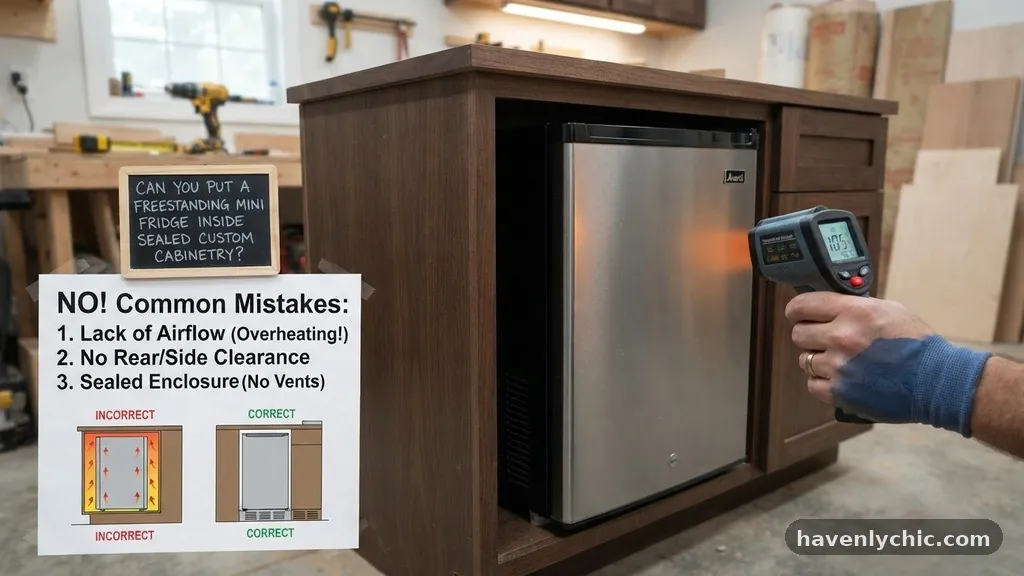
One of the most common errors is failing to account for the thickness of the cabinet materials. When you measure for your “built-in” look, you must ensure that the internal dimensions of the cabinet exceed the appliance dimensions by the required margins.
Another frequent mistake is neglecting the power cord and plug. You need to ensure there is enough space behind the unit for the plug to sit comfortably without being crushed against the back wall, which can create a fire hazard.
Do not assume that because the fridge is “small,” it generates less heat. A small compressor working hard in a small space can generate just as much heat as a larger unit.
Avoid using solid wood doors if you are trying to hide the unit; if you must use a door, use a mesh or louvered style that allows for maximum air exchange. Finally, never place the unit on a thick carpet or rug inside the cabinet, as this blocks any potential air movement from beneath the unit.
Checklist for a Successful Enclosure
If you are moving forward with a custom cabinet project, use this checklist to ensure you are covering the basics for a safe and functional installation.
- Verify the manufacturer’s manual for specific rear and side clearance requirements.
- Ensure the cabinet depth allows for the fridge plus at least 2 inches of rear space for air circulation.
- Install air intake and exhaust vents if the cabinet is intended to be closed.
- Use a dedicated electrical outlet that is easily accessible for maintenance or emergencies.
- Confirm that the cabinet floor is level and solid to prevent vibration noise.
- Consider an active cooling fan system if you are working with a tight, enclosed space.
- Avoid placing the fridge near heat-producing appliances like ovens or microwaves.
Frequently Asked Questions
Can I remove the back panel of my cabinet to make it work?
Removing the back panel is one of the most effective ways to allow a freestanding unit to breathe. It creates a direct path for heat to escape into the wall cavity or the room behind the cabinet. Just ensure that the unit is still secured so it does not shift or tip over.
Do I need a special outlet for a mini fridge inside a cabinet?
You do not need a special high-voltage outlet, but you should ensure the outlet is grounded and easily accessible. Avoid using long extension cords, as they can overheat. It is best to have the receptacle installed inside the cabinet or immediately adjacent to it by a licensed electrician.
Will a cabinet fan really make a difference?
Yes, an active ventilation fan can significantly reduce the internal temperature of a cabinet enclosure. By forcing hot air out, you mimic the natural convection that the fridge needs to function. Look for “cabinet cooling fans” that are designed to be quiet and energy-efficient.
What happens if I ignore the manufacturer’s clearance specs?
Ignoring these specifications will almost certainly void your warranty. If the unit fails, the manufacturer will likely be able to tell that it was installed in a non-compliant environment due to signs of heat damage on the compressor. You will be left with a broken appliance and no recourse for repair or replacement.
Is it safer to buy a built-in fridge from the start?
Yes, buying a unit specifically designed for built-in installation is the safest and most reliable approach. These units are built with front-venting technology, which eliminates the need for complex cabinet modifications. While they are usually more expensive, they provide peace of mind and are much easier to integrate into high-end cabinetry designs.
Conclusion
Successfully integrating a cooling unit into your home requires balancing aesthetic goals with mechanical realities. Can you put a freestanding mini fridge inside sealed custom cabinetry While technically possible with significant modifications, it is rarely the optimal choice due to the risks of overheating and equipment failure. If you prioritize the long-term health of your appliance, investing in a proper built-in model is the most straightforward path.
If you must use a freestanding unit, prioritize ventilation above all else, ensuring that your custom joinery allows for adequate airflow through grilles or open-back designs. By respecting the physics of heat transfer, you can enjoy the convenience of a hidden fridge without the headaches of a failing system. Reach out to a professional cabinet maker or appliance specialist if you have specific concerns about your installation plan.